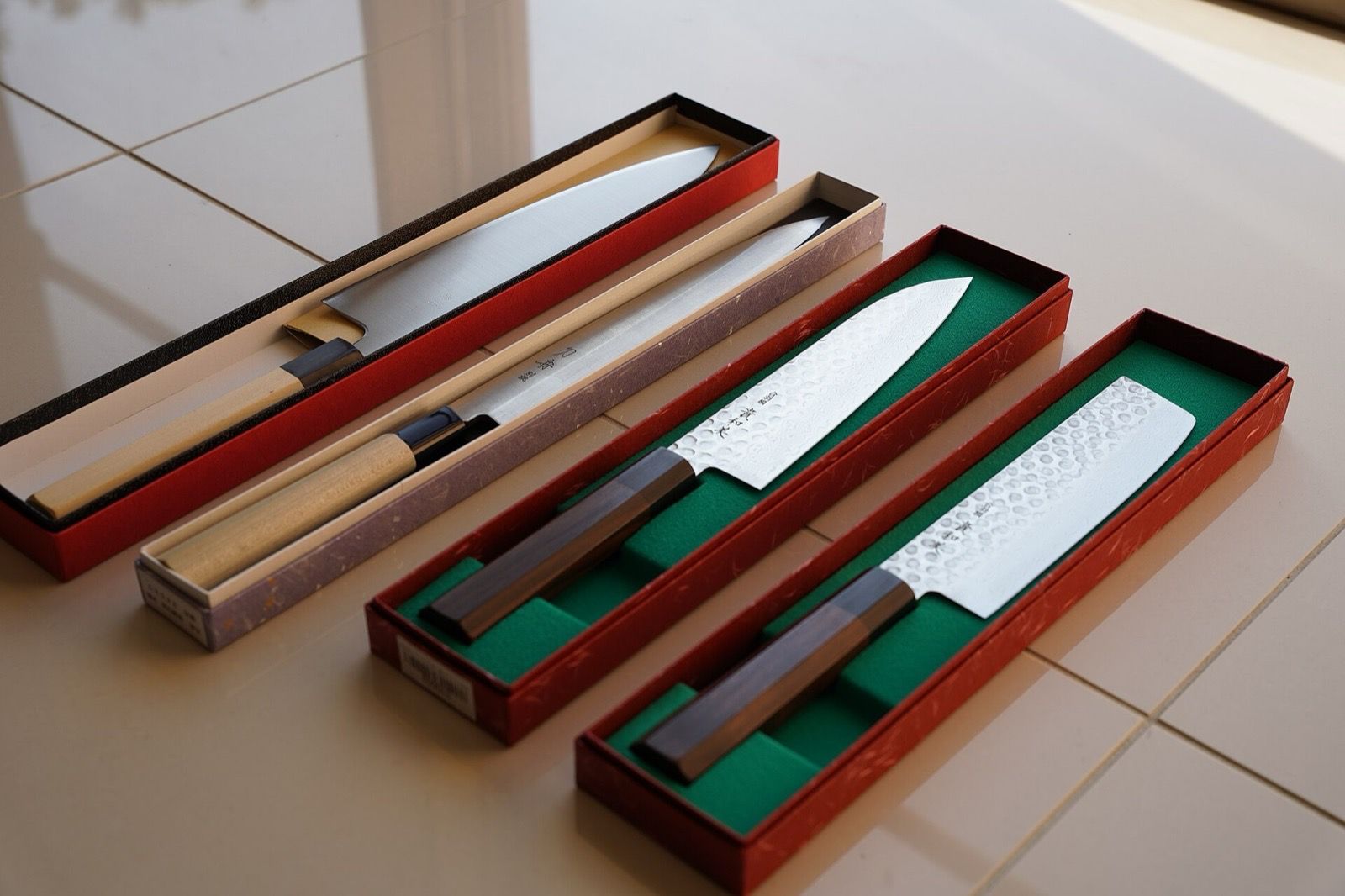
Most people who buy their first Japanese knife end up choosing between the same two blades. The gyuto looks familiar: it is Japan’s version of the European chef’s knife. The santoku looks different: shorter, flatter, with a blunt, dropped tip. Outside Japan the two are sold side by side, as equals. Inside Japan, they are not.
What Japanese homes actually use
Surveys agree. In a 2022 online survey of 560 women in Japan, 96.2% said they own a santoku, far more than any other type (Kodomo Living). Knife maker Kai calls it the most widespread knife in Japanese homes (Kai).
Two knives built for the same job
Gyūtō means “beef sword”. The shape came to Japan with Western cooking and was made thinner and harder, which is why a 210 mm gyuto feels lighter than a German chef’s knife of the same size. Its curved belly lets you rock the blade, and its point gets into tight spaces.
Santoku is usually translated as “three virtues”, for meat, fish and vegetables. Its edge is flatter and its tip drops down to meet it, so it meets the board along most of its length. It is made for pushing straight down and forward through food.
| Santoku | Gyuto | |
|---|---|---|
| Japanese name | 三徳 | 牛刀 |
| Also sold as | – | Chef’s knife |
| Usual edge | Double bevel | Double bevel |
| Common lengths | 165, 180 mm | 180, 210, 240, 270 mm |
| Cutting motion | Push down and forward | Rock on the curve, or push |
When a gyuto is the better first knife
Watch yourself chop an onion. If the tip of your knife stays on the board while the heel rises and falls, you rock-chop, and a gyuto’s curve will feel natural. If you lift the whole blade and push it down and forward, a santoku will feel natural.
Board size matters too. A 240 mm gyuto needs a board around 45 cm long to be comfortable. A santoku is at home on a small board in a narrow kitchen.
Don’t overthink the length
For reference, most santoku are 165 or 180 mm long. Gyuto run from 180 to 270 mm, and 210 mm is the usual size for a home kitchen.
Stainless first
Shape decides how a knife cuts. Steel decides how you live with it. Most santoku sold today are stainless or powder steel, and that is where to start. Read carbon or stainless if you are tempted by carbon.
Where to start
- Stainless santoku, 165–180 mm The usual santoku lengths. Stainless steel, double bevel.
- Stainless gyuto, 210 mm If you already rock-chop with a chef's knife.
- Bunka, if you can't decide Santoku-sized, with a pointed, angular tip.
Each link opens an Amazon search, not one product we picked. Check the listing for the details above, the price and shipping to your country.
Questions people ask
Can a santoku cut meat?
Yes. The name is usually explained as 'three virtues': meat, fish and vegetables. Our editor keeps separate santoku for meat, fish and vegetables at home.
Are these knives fine for left-handed cooks?
Almost always. Gyuto and santoku are sharpened on both sides (double bevel). Check the listing for 'single bevel' or '70/30', which some makers offer.
Do I need a whetstone?
Not to start. Most Japanese homes use a simple sharpener or a sharpening service. See our guide to how Japanese home cooks really sharpen.
Do I need both?
No. Most people do well with one of them plus a small petty knife for peeling and trimming.
Sources and checks (2)
- Kodomo Living (こどもりびんぐ), women's knife survey, Nov 2022 Used for: 96.2% of 560 respondents owning a santoku. Checked 3 Nov 2026.
- Kai (貝印), KAI LIFE: 三徳包丁とは Used for: The santoku as the most widespread knife in Japanese homes. Checked 3 Nov 2026.
Notes from our editor, Shota Ando, come from recorded conversations, dated on each note. Published facts come from the sources above, which we reopen and check against the text. Amazon links are searches, not paid placements. How we work
Photo credit: Benlisquare, CC BY-SA 4.0, via Wikimedia Commons. Resized and converted to WebP and AVIF.